What Farmland’s Quiet Consolidation Means for Land Markets
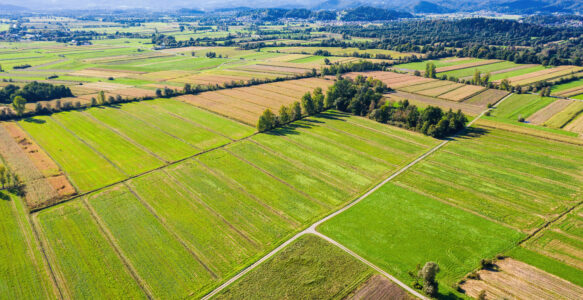
Financial pressure on farm operators is creating a rare window for institutional capital to enter one of the country’s largest and most fragmented land markets.
This Market Tales × WCBC special, recorded live at CBC Global Conference 2026, features Kelsey Ward in conversation with Ashley Wilson on agility, influence, and next-gen CRE leadership — plus an exclusive Women of CBC lightning round with Jenna Hille. Kelsey’s path from architect to broker is anything but linear — she brings a rare design-meets-dealmaker perspective to creative financing, adaptive reuse, and what it means to build a career and a reputation at the same time in commercial real estate.
Artificial intelligence has pushed data centers to the center of the commercial real estate conversation. Capital continues flowing into digital infrastructure as cloud providers and technology firms race to expand computing capacity. Development pipelines are growing across major markets, and investors increasingly treat the sector as one of the most attractive areas of institutional real estate.
For decades, office leasing decisions followed a familiar checklist: location, rent, amenities and layout. Today another factor increasingly sits near the top of that list: capital stability.
Corporate expansion decisions leave a visible footprint. When companies build manufacturing plants, logistics hubs, data centers or office campuses, they are making long-term bets on labor markets, infrastructure, operating costs and regulatory environments. Taken together, those decisions form one of the clearest indicators of where commercial real estate demand will emerge next.
Coworking is making a comeback, but it looks very different than it did five years ago. The pandemic, combined with the high-profile struggles of companies like WeWork, raised questions about whether shared office space could survive in a remote-first world. But instead of disappearing, coworking has quietly evolved. Today, a new generation of flexible workspace models is helping bring the sector back to life.
Demography is the quiet engine under real estate. Buildings don’t create demand; people do. When population patterns change, the built environment eventually follows
Commercial real estate cycles rarely announce themselves with a bell. They tend to reveal their turning points through smaller signals first.
A 1031 exchange allows investors to defer capital-gains taxes when selling an investment property and reinvesting the proceeds into another qualifying asset.
Institutional capital is flowing back into private real estate—but with a sharper lens and a more selective mandate than in prior cycles. Allocators are not simply returning to real estate; they are recalibrating toward sectors and structures that promise durability, income visibility and downside protection.